

























Magnitude 5.7 quake shakes West Papua’s coastal zone
A magnitude 5.7 earthquake struck off the coast of West Papua province in Indonesia on Tuesday, recording a shallow depth that had authorities monitoring a broad swath of Papua’s coastal communities for shaking effects, according to seismic data from international observatories. The German Research Centre for Geosciences and seismic networks reported the tremor’s epicentre in the Ceram Sea region of West Papua, with a hypocentral depth of […] The article Magnitude 5.7 quake shakes West Papua’s coastal zone appeared first on Arabian Post.
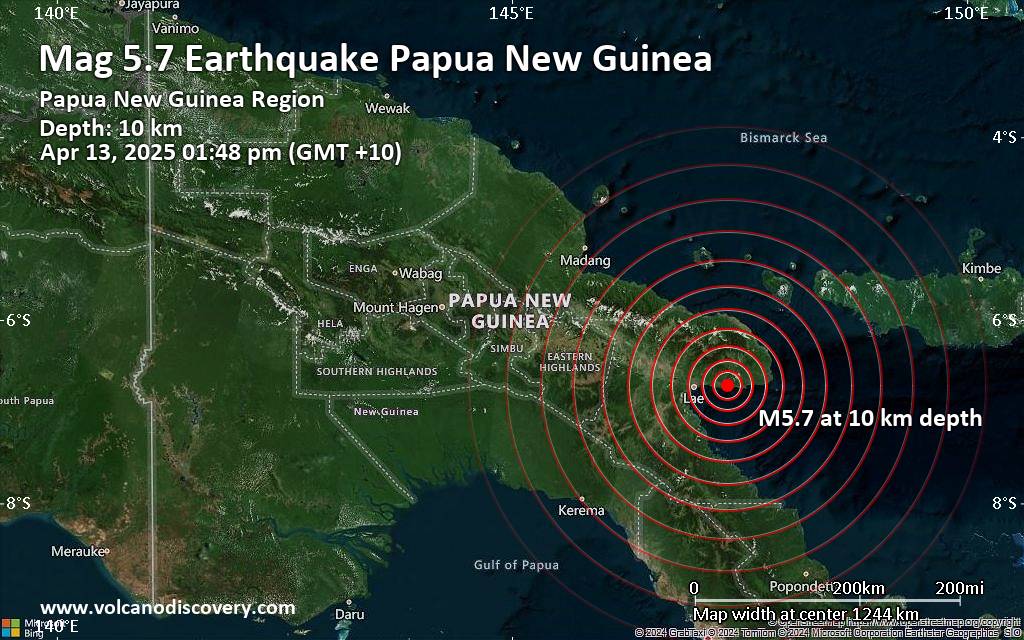
A magnitude 5.7 earthquake struck off the coast of West Papua province in Indonesia on Tuesday, recording a shallow depth that had authorities monitoring a broad swath of Papua’s coastal communities for shaking effects, according to seismic data from international observatories. The German Research Centre for Geosciences and seismic networks reported the tremor’s epicentre in the Ceram Sea region of West Papua, with a hypocentral depth of about 10 kilometres, a level that can amplify ground motion over surrounding areas. No immediate emergency alerts for widespread damage or casualties were issued in the hours after the shaking, though local officials said they were gathering reports from affected villages and towns.
Seismologists tracking activity across the Pacific Ring of Fire noted that this event aligns with frequent moderate seismicity in eastern Indonesia, a region situated where the Australian, Pacific, and Eurasian tectonic plates converge and interact. Over recent months, geophysical agencies have documented several magnitude-5-plus events in the broader Papua and Maluku provinces, reflecting ongoing stress accumulation along complex fault systems that criss-cross the archipelago. Indonesia as a whole averages a high rate of earthquakes, including larger and destructive shocks in historical records, though many occur offshore or at depths that limit severe damage.
Local disaster management officials in West Papua province said they had received scattered reports of shaking felt on land in coastal settlements, particularly in Sarmi and Nabire regencies. Initial field checks by community volunteers and village leaders indicated that building damage appeared limited to minor cracks in plaster or loose objects shifting indoors. There were no confirmed reports of injuries or infrastructure collapse at the time of reporting, but emergency teams continued assessments, especially in more isolated coastal communities where communication infrastructure can slow information flow. Officials reiterated public preparedness guidance, urging residents to familiarise themselves with evacuation routes and to inspect structures for safety.
Experts emphasised that while the 5.7 magnitude class of earthquakes can produce noticeable shaking, especially if shallow, the potential for severe destruction diminishes with distance from populated centres and where local construction adheres to seismic-resistant standards. In West Papua, many rural houses are built using lightweight materials that fare better in moderate quakes than heavy, brittle concrete structures. Urban centres with denser infrastructure, meanwhile, benefit from updated building codes implemented after major earthquakes in Indonesia over the past decade.
Indonesia’s Meteorology, Climatology, and Geophysics Agency continues to monitor aftershock activity, which typically follows moderate to strong earthquakes and can persist for days to weeks. Aftershock sequences, while smaller in magnitude, pose risks of localized damage and complicate ongoing damage assessments. Seismic experts encouraged residents to report felt shaking on official platforms to help refine the understanding of the quake’s impacts and to support rapid response planning.
Previous episodes in the region have highlighted the varied impacts moderate seismic events can have. For instance, even magnitude-5-plus quakes have in the past shaken buildings and infrastructure in densely populated zones of Java and Sumatra, prompting temporary closures of schools and public facilities as safety checks were conducted. In West Papua and neighbouring provinces, the interplay of offshore epicentres and coastal geography underscores the importance of integrating tsunami hazard readiness, even when initial shaking does not immediately trigger a marine threat.
Community leaders and regional authorities in West Papua reaffirmed their commitment to disaster risk reduction, citing investments in early warning systems, evacuation drills, and public education campaigns that have expanded over the last decade. These efforts aim to build resilience in a province that, while less densely populated than Java or Bali, encompasses vulnerable coastal communities and vital transportation routes linking Papua with the wider Indonesian archipelago. Regular engagement with residents on preparedness, combined with real-time seismic data sharing, forms a core component of local resilience strategies.
The article Magnitude 5.7 quake shakes West Papua’s coastal zone appeared first on Arabian Post.
What's Your Reaction?