



























Supply chain attacks emerge as ‘top global cyber threat’
A leading creator of cybersecurity technologies to investigate, prevent, and fight digital crime, launched its High-Tech Crime Trends Report 2026, revealing that supply chain attacks have become the dominant force reshaping the global cyber threat landscape.Across the MEA region, Internet and Financial services account for over 80% of phishing activity, highlighting identity compromise as the gateway to cascading supply-chain attacks.The High-Tech Crime Trends report presented by Group-IB in a media event held in TODA, Madinat Jumeirah Dubai, was attended by the firm’s top management, including Dmitry Volkov, Chief Executive Officer of Group-IB and many others. “Cybercrime is no longer defined by single breaches. It is defined by cascading failures of trust,” Volkov said.“Attackers are industrialising supply chain compromise because it delivers scale, speed, and stealth. A single upstream breach can now ripple across entire industries. Defenders must stop thinking in terms of isolated systems and start securing trust itself, across every relationship, identity, and dependency.”He also pointed that, “For organisations across the Middle East & Africa (MEA), where cloud adoption, digital government platforms and fintech ecosystems continue to expand rapidly, the shift towards supply chain compromise represents a growing systemic risk rather than isolated security incidents.”This year’s High-Tech Crime Trends report reveals that cybercrime has shifted decisively away from isolated intrusions toward ecosystem-wide compromise, where attackers exploit trusted vendors, open-source software, SaaS platforms, browser extensions, and managed service providers to gain inherited access to hundreds of downstream organisations.In MEA, phishing activity observed by Group-IB in 2025 shows attackers disproportionately targeting high impact sectors, particularly internet services (52.49%), financial institutions (28.50%) and the logistics sector (11.20%). Although phishing often starts with individual users, compromise within these organisations can trigger cascading effects across customers, partners, and connected ecosystems. Drawing on worldwide telemetry alongside on-the-ground investigations, the report combines Group-IB’s adversary-centric and global analysis with real-world regional case studies to illustrate how supply chain compromises unfold across industries and geographies.
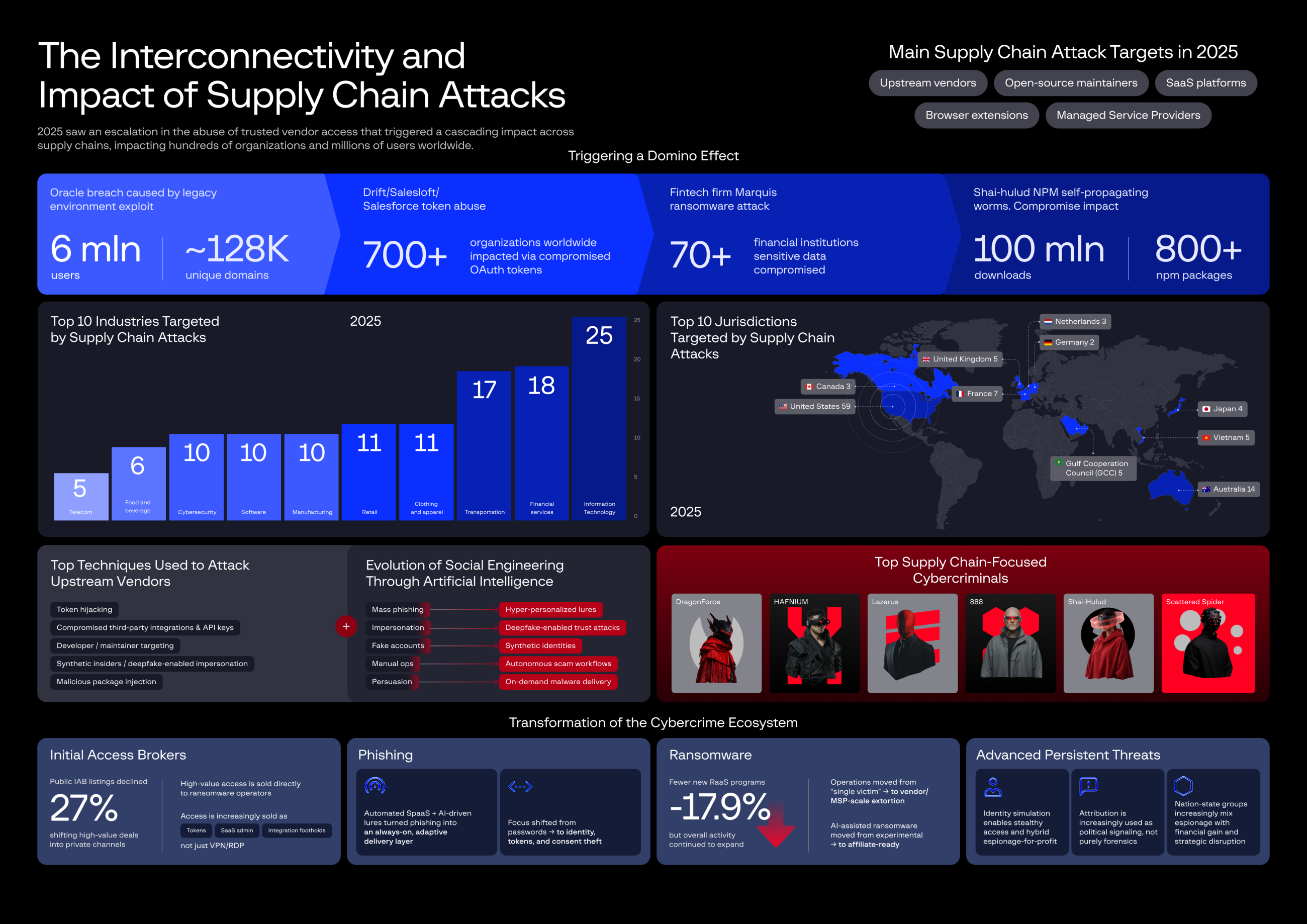
A leading creator of cybersecurity technologies to investigate, prevent, and fight digital crime, launched its High-Tech Crime Trends Report 2026, revealing that supply chain attacks have become the dominant force reshaping the global cyber threat landscape.Across the MEA region, Internet and Financial services account for over 80% of phishing activity, highlighting identity compromise as the gateway to cascading supply-chain attacks.The High-Tech Crime Trends report presented by Group-IB in a media event held in TODA, Madinat Jumeirah Dubai, was attended by the firm’s top management, including Dmitry Volkov, Chief Executive Officer of Group-IB and many others. “Cybercrime is no longer defined by single breaches. It is defined by cascading failures of trust,” Volkov said.“Attackers are industrialising supply chain compromise because it delivers scale, speed, and stealth. A single upstream breach can now ripple across entire industries. Defenders must stop thinking in terms of isolated systems and start securing trust itself, across every relationship, identity, and dependency.”He also pointed that, “For organisations across the Middle East & Africa (MEA), where cloud adoption, digital government platforms and fintech ecosystems continue to expand rapidly, the shift towards supply chain compromise represents a growing systemic risk rather than isolated security incidents.”This year’s High-Tech Crime Trends report reveals that cybercrime has shifted decisively away from isolated intrusions toward ecosystem-wide compromise, where attackers exploit trusted vendors, open-source software, SaaS platforms, browser extensions, and managed service providers to gain inherited access to hundreds of downstream organisations.In MEA, phishing activity observed by Group-IB in 2025 shows attackers disproportionately targeting high impact sectors, particularly internet services (52.49%), financial institutions (28.50%) and the logistics sector (11.20%). Although phishing often starts with individual users, compromise within these organisations can trigger cascading effects across customers, partners, and connected ecosystems. Drawing on worldwide telemetry alongside on-the-ground investigations, the report combines Group-IB’s adversary-centric and global analysis with real-world regional case studies to illustrate how supply chain compromises unfold across industries and geographies.
What's Your Reaction?








DDP Editor
Admin managing news updates, RSS feed curation, and PR content publishing. Focused on timely, accurate, and impactful information delivery.