

























Kim hails engine test sharpening US strike reach
North Korea has carried out a ground test of a newly upgraded high-thrust solid-fuel engine, with leader Kim Jong-un saying the development would strengthen the country’s strategic strike capability and advance its military modernisation drive. State media said Kim observed the test and described it as an important step in the ruling party’s five-year defence plan, a programme that has centred on building faster-launching missiles and a […]The article Kim hails engine test sharpening US strike reach appeared first on Arabian Post.
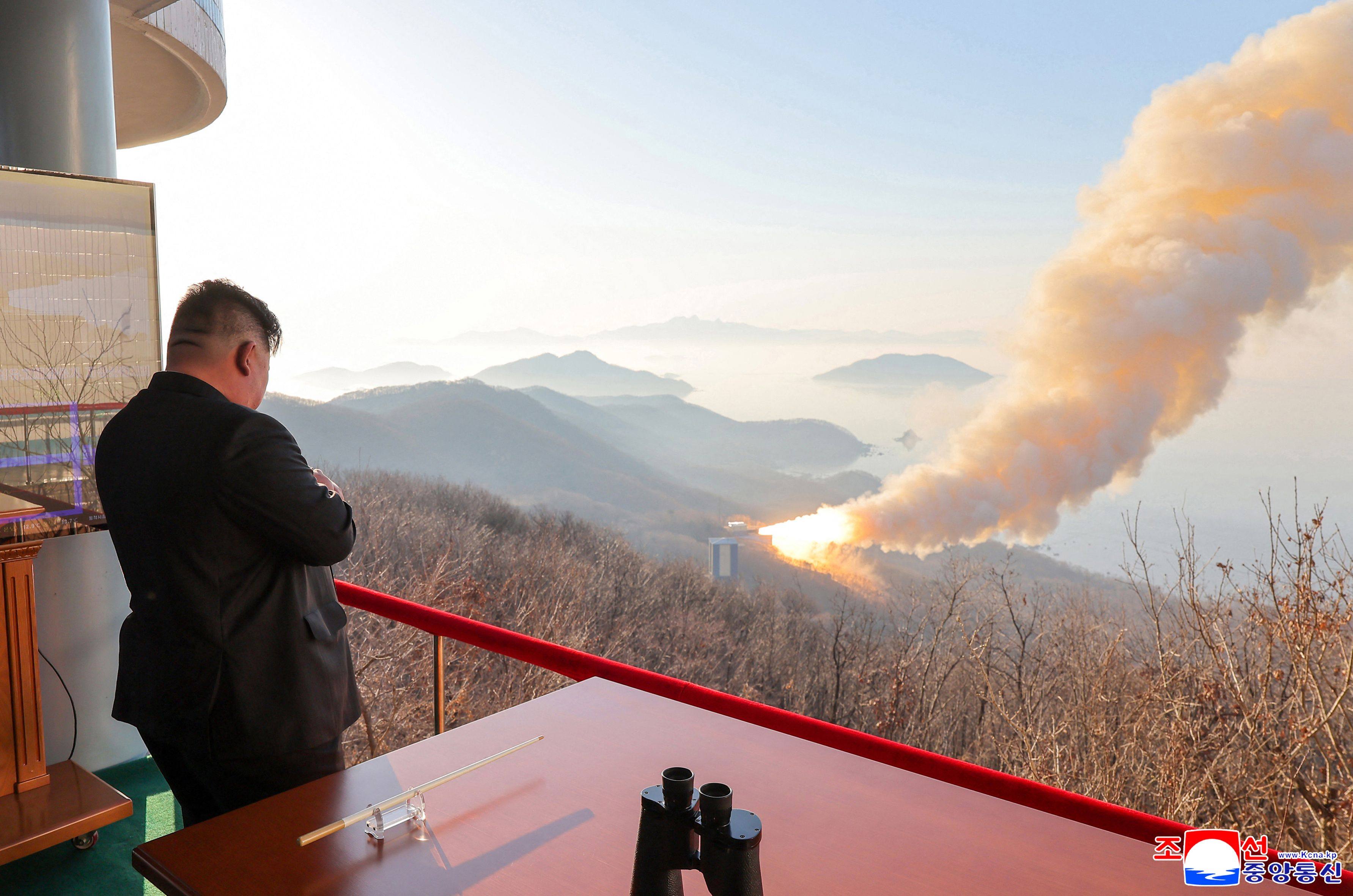
North Korea has carried out a ground test of a newly upgraded high-thrust solid-fuel engine, with leader Kim Jong-un saying the development would strengthen the country’s strategic strike capability and advance its military modernisation drive. State media said Kim observed the test and described it as an important step in the ruling party’s five-year defence plan, a programme that has centred on building faster-launching missiles and a more survivable nuclear force.
The reported test, disclosed by the Korean Central News Agency on Sunday, involved an engine made with composite carbon-fibre material and delivering a maximum thrust of 2,500 kilonewtons. That figure is higher than the 1,971 kilonewtons cited for a similar test conducted in September last year, according to Yonhap’s account of the KCNA report. Analysts say that, if the figures are accurate, the engine could support a heavier or more advanced solid-fuel long-range missile, potentially including an intercontinental ballistic missile designed to reach the United States mainland.
Solid-fuel systems hold particular significance because they can be moved and fired more quickly than liquid-fuel missiles, which need longer preparation and are more vulnerable to detection before launch. That has made them a central focus of Pyongyang’s weapons effort as it seeks to make its missile force harder to track and disrupt. North Korea has already tested solid-fuel intercontinental systems, and the latest engine test appears aimed at improving performance, payload options and possibly the eventual deployment of multiple warheads or more mobile launch platforms.
State media did not disclose the date or location of the engine trial, but Kim used the occasion to frame it as part of a broader campaign to expand what Pyongyang calls its nuclear deterrent. That message fits the tone he has adopted this month. In a speech to the Supreme People’s Assembly on 23 March, Kim said the country’s nuclear status was irreversible and signalled no willingness to trade away its weapons programme for economic or diplomatic concessions. He also renewed accusations that Washington and its allies were maintaining a hostile posture towards Pyongyang.
The latest test comes at a time when North Korea is pairing strategic weapons development with a wider display of conventional military upgrades. Reuters reported that Kim also inspected special operations training and a new main battle tank during the same burst of state media coverage, underscoring an effort to show progress across several arms programmes at once. That pattern suggests Pyongyang is trying to project strength domestically while also signalling to Seoul, Tokyo and Washington that its weapons pipeline remains active despite sanctions and diplomatic isolation.
Outside experts remain cautious about treating North Korean claims at face value. AP reported that some specialists noted the absence of crucial technical details such as burn duration, test conditions and integration plans, all of which matter in judging whether an engine can reliably power an operational long-range missile. There is also a long record of North Korean weapons announcements offering only partial evidence. Even so, many analysts see the progression from earlier solid-fuel work to this higher-thrust test as consistent with a longer-term effort to field more sophisticated intercontinental systems.
Another question hanging over the programme is whether North Korea is receiving outside help. Some South Korean analysts, cited by AP, have raised the possibility that military cooperation with Russia could accelerate parts of Pyongyang’s missile development, though direct evidence tied to this specific engine test has not been made public. Defence officials and researchers have been watching that relationship closely as ties between Pyongyang and Moscow deepen, particularly over security and military exchanges.
For the United States and its regional allies, the significance of the test lies less in a single engine firing than in the direction of travel. North Korea is moving methodically towards missile forces that are quicker to deploy, harder to pre-empt and potentially more flexible in how they deliver a payload. The combination of solid-fuel propulsion, continued ICBM development and Kim’s insistence that nuclear weapons are permanent points to a security environment on the Korean peninsula that is becoming more entrenched and less open to the kind of bargaining that shaped earlier diplomacy.
The article Kim hails engine test sharpening US strike reach appeared first on Arabian Post.
What's Your Reaction?