


















Rosatom and DP World redraw logistics map
Arabian Post Staff -Dubai Rosatom has agreed to form a logistics joint venture with DP World in a deal that would place Russia’s state nuclear corporation in majority control while bringing one of Dubai’s biggest global trade operators deeper into a strategically sensitive transport network centred on FESCO and Arctic shipping lanes. Under the proposed structure, Rosatom will hold 51% and DP World 49%, with Rosatom contributing […]The article Rosatom and DP World redraw logistics map appeared first on Arabian Post.
Arabian Post Staff -Dubai

Rosatom has agreed to form a logistics joint venture with DP World in a deal that would place Russia’s state nuclear corporation in majority control while bringing one of Dubai’s biggest global trade operators deeper into a strategically sensitive transport network centred on FESCO and Arctic shipping lanes. Under the proposed structure, Rosatom will hold 51% and DP World 49%, with Rosatom contributing its 92.4% stake in Russian transport group FESCO and DP World injecting cash linked to FESCO’s market valuation. The transaction still requires clearance from Russia’s government commission on foreign investment and the Federal Antimonopoly Service.
The agreement marks a significant broadening of Rosatom’s commercial ambitions beyond nuclear power. While the corporation remains best known for building reactors at home and abroad, it has steadily expanded its transport role through oversight of the Northern Sea Route and, more recently, through control of FESCO, one of Russia’s best-known container and intermodal logistics groups. That combination gives Rosatom influence over both physical cargo movement and one of Moscow’s most heavily promoted trade corridors, linking domestic transport policy to wider geopolitical and commercial goals.
FESCO is the operational heart of the proposed venture. The group describes itself as an integrated transport business spanning sea, rail, truck, terminal and warehousing services, with container corridors connecting Russia to China, South-East Asia and the Middle East. It also runs dedicated services between Russia and India through St Petersburg, Novorossiysk and Vladivostok. Folding that network into a jointly owned platform with DP World would give the venture an immediate operating base rather than a purely greenfield start, and it would provide DP World with a position in an established Eurasian freight system at a time when trade routes continue to adjust to sanctions, war risk and shifting supply chains.
For DP World, the move fits its push to build an integrated logistics model that extends well beyond port terminals. The Dubai group said in its 2025 annual reporting that it delivered strong growth in a volatile trade environment, while its full-year 2025 results showed record revenue of $24.4 billion and EBITDA of $6.4 billion. The company’s scale, capital strength and global network make it an attractive partner for Rosatom, which is seeking access to broader international infrastructure and cargo flows. Rosatom has made clear that the partnership is intended to help build a global logistics operator and raise throughput, including along the Northern Sea Route.
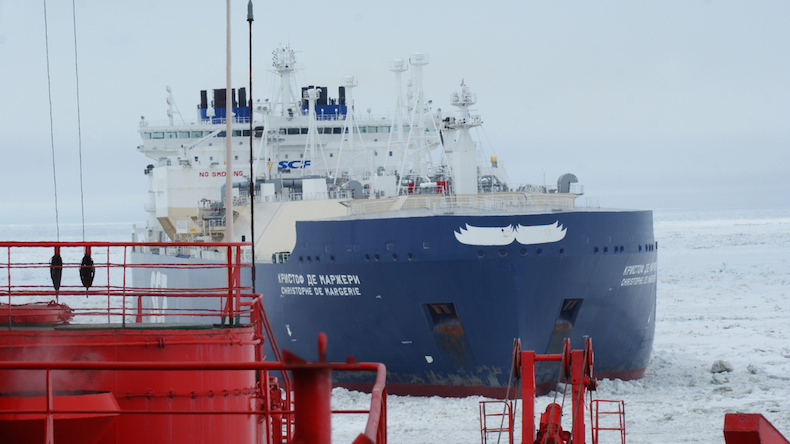
That Arctic route remains central to the industrial logic of the deal. Rosatom, which is responsible for development of the corridor, has been promoting it as a shorter link between Europe and Asia, backed by nuclear icebreaker support and state infrastructure investment. The corporation said cargo shipped along the route reached nearly 38 million tonnes in 2024, while it later projected further growth and reported strong interest from foreign-flagged vessels for 2025 navigation. Supporters in Moscow view the lane as both a commercial opportunity and a symbol of economic resilience. Critics, however, note that seasonal constraints, insurance concerns, high capital costs and sanctions-related frictions continue to limit how far the corridor can rival conventional routes.
The political and legal backdrop is equally important. Rosatom’s control of FESCO stems from a state transfer that followed the seizure of shares formerly held by Ziyavudin Magomedov and associates. Reuters reported in 2023 that a Russian court transferred 92.4% of FESCO to the state earlier that year, and President Vladimir Putin later approved moving those shares to Rosatom. That history has kept FESCO tied to wider disputes over asset ownership and sanctions-era restructuring. It also means the new venture arrives with baggage beyond commerce, particularly for international observers watching how large Russian strategic assets are being repackaged and partnered.
There is also a strong element of continuity rather than surprise. Interfax reported that Rosatom and DP World already had a joint venture dating from 2023 focused on container shipping through the Arctic, and Russian media had flagged talks over a broader FESCO-based arrangement months before this week’s announcement. The latest agreement therefore appears to formalise a relationship that has been developing in stages, with the new structure potentially offering more scale, more cargo optionality and a stronger institutional framework for international expansion.
The article Rosatom and DP World redraw logistics map appeared first on Arabian Post.
What's Your Reaction?