




























Fueling student passion for STEM with project-based learning
We live in an ever-evolving world, powered by advancements across STEM fields. Today, STEM has become increasingly intertwined with how we live our daily lives--from how we learn, to how we work, to entertainment and more.
Key points:
- PBL is an integral tool that fuels a lifelong passion for STEM
- How to make project-based learning a reality
- PBL isn’t used enough–let’s change that
- For more on PBL, visit eSN’s Innovative Teaching hub
We live in an ever-evolving world, powered by advancements across STEM fields. Today, STEM has become increasingly intertwined with how we live our daily lives–from how we learn, to how we work, to entertainment and more.
STEM innovations are a major force driving society forward, as we’ve most recently seen with the AI explosion that is generating a growing demand for STEM talent in the workforce. In fact, STEM employment is set to increase nearly 3x the rate of non-STEM employment by 2033.
As teachers, our job is to equip students to excel in our dynamic world–not only within the classroom, but to also empower them to build foundational skills that will help them to thrive when they enter the workforce.
As STEM talent continues to become vital, these skills are ones K-12 teachers must ensure we’re implementing in our classrooms, because introducing STEM education early on helps spark curiosity among students.
So, what can teachers do to fuel a passion for STEM among their students?
The power of project-based learning
Project-based learning (PBL) is proving itself to be a successful pedagogy–nearly half (46%) of K-12 Gen Z students say opportunities to engage with learning material in a hands-on way drive their interest, and about one-third most enjoy what they’re learning when they can make real-world connections.
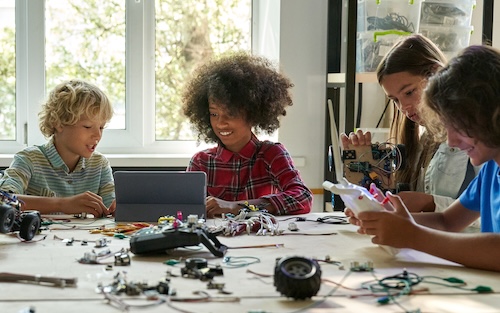
PBL is an alternative to traditional rote learning methods. When applying PBL to STEM education, instead of having students listening passively to information, they actively engage in real-world problems that require them to use STEM concepts to solve complex problems. This hands-on approach allows students to develop a deeper sense of knowledge of the topic they’re learning about–they’re not just merely memorizing but also learning from its applications. For instance, in a PBL setting, students could identify lack of access to filtered water as a problem and then work together to design a sustainable water filtration system to address this challenge.
PBL helps students not only supplement theoretical knowledge but also provide a sense of purpose and applicability. It helps enhance the learning experience for students by making it enjoyable and allowing students to see the impact they can bring out into the world beyond the classroom.
When it comes to STEM, PBL plays a powerful role in tapping into students’ curiosity. STEM curriculums aren’t typically viewed as ones that power creativity, but by framing learning in terms of interesting questions or issues, PBL allows students to explore, experiment and learn these topics in a unique way that allows them to become innovators in the classroom. This process can be highly motivating, allowing students to become agents in their own learning process. The sense of ownership and pride that comes with successfully finishing a challenging project can ignite a lifetime interest in STEM.
Building the skills to power future STEM innovators
PBL helps enhance learning experiences for students by making the process more exciting and engaging, and it also allows them to develop and foster crucial skills that are necessary in our STEM-powered world.
By introducing PBL into the classroom, students are given the opportunity to work closely together on project work, which allows them to harness core skills like collaboration, clear communication, vital problem-solving abilities, creativity and perseverance. These skills are ones that empower students throughout their education journey–from K-12 and beyond–and are also essential for STEM career success. Encouraging skills like creativity in students’ developmental years empowers them to think outside of the box–a crucial competency for STEM professionals. Creativity drives innovation, and helping students to flex and build this muscle early on will allow them to enter the STEM workforce ready to drive change.
Figuring out how to implement PBL can feel overwhelming, especially if the existing curriculum doesn’t allow room for this approach. Luckily for teachers, there are a plethora of great programs, like the National Science Teaching Association and Toshiba’s ExploraVision, which offer support and resources to make PBL opportunities a reality, helping us spark a passion for STEM among our students.
Shaping STEM leaders in the classroom
As we’ve seen with AI’s rapid advancements, STEM fields are shaping the nation’s future. Today’s students are soon to become the future leaders of tomorrow. Teachers bear a responsibility to prepare them with the skills they need to thrive in their education–as well as in the workplace.
Project-based learning is a critical, and proven, means of providing students with hands-on, experiential learning that nurtures curiosity, skills and a sense of purpose. As we prepare our students to address the challenges and opportunities of the future, PBL is an integral and effective tool, fueling a lifelong passion for STEM and equipping students with the skills necessary to become strong STEM leaders.
What's Your Reaction?