






























UAE rail network tests maglev freight leap
Arabian Post Staff -Dubai Etihad Rail has taken a significant step towards reshaping freight transport in the Gulf after completing a magnetic levitation freight trial with Italy-based technology firm IronLev, marking the first time such a system has been tested in the Middle East. The trial, conducted at the Al Faya Depot, demonstrated the ability of a maglev platform to move heavy cargo efficiently, signalling a potential […] The article UAE rail network tests maglev freight leap appeared first on Arabian Post.


Arabian Post Staff -Dubai
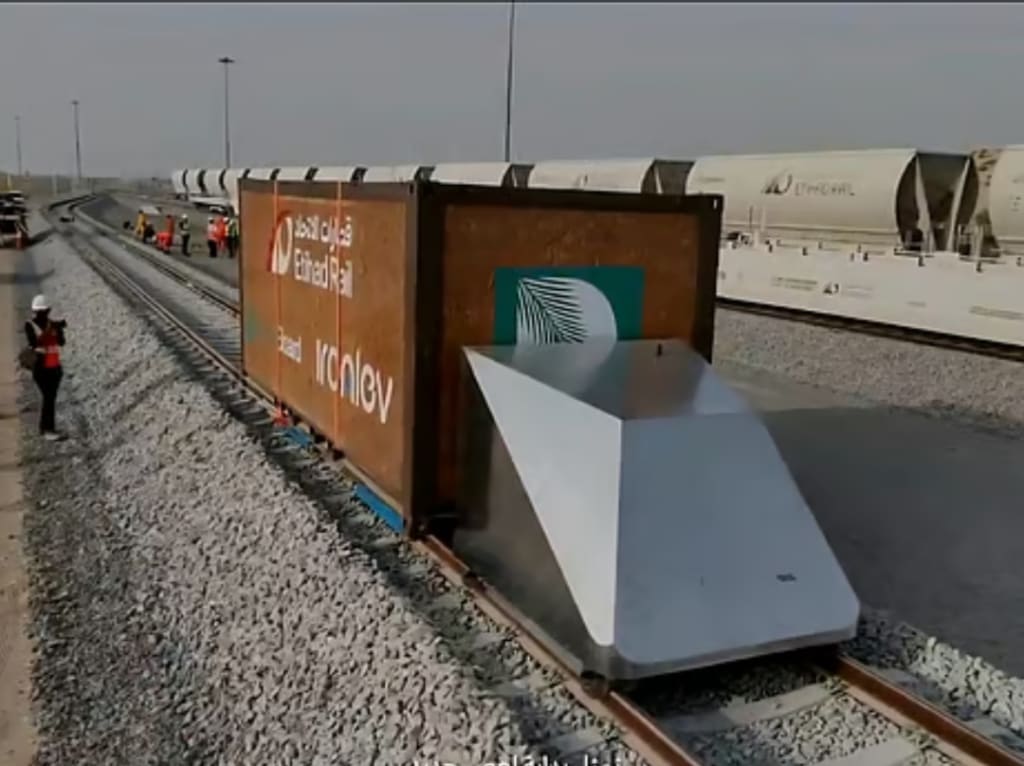
Etihad Rail has taken a significant step towards reshaping freight transport in the Gulf after completing a magnetic levitation freight trial with Italy-based technology firm IronLev, marking the first time such a system has been tested in the Middle East. The trial, conducted at the Al Faya Depot, demonstrated the ability of a maglev platform to move heavy cargo efficiently, signalling a potential shift in how goods could be transported across the region in the decades ahead.
The test run involved a levitating platform carrying a fully loaded 7-tonne container over a distance of 1.2 kilometres. Engineers involved in the trial said the system performed within expected parameters, maintaining stability and speed while reducing friction to near zero. For Etihad Rail, the developer and operator of the UAE National Railway Network, the collaboration represents an exploration of advanced technologies that could complement conventional rail infrastructure rather than replace it outright.
Magnetic levitation systems differ from traditional rail by lifting vehicles above the track using electromagnetic forces, eliminating direct contact between wheels and rails. This allows for smoother movement, lower mechanical wear, and potentially higher energy efficiency. While maglev technology has been used for passenger transport in parts of East Asia and Europe, its application to heavy freight remains limited globally, making the UAE trial notable for the logistics sector.
Etihad Rail officials involved in the project have indicated that the trial was designed to test feasibility rather than signal immediate commercial deployment. The focus was on understanding how maglev could integrate with existing freight corridors, particularly for industrial and port-related logistics where heavy loads and predictable routes are common. The Al Faya Depot, situated along key freight pathways, was selected to replicate operational conditions as closely as possible.
IronLev, a spin-off specialising in passive magnetic levitation systems, has positioned its technology as adaptable to existing rail infrastructure with modifications. Unlike high-speed passenger maglev lines that require entirely new tracks, IronLev’s approach is designed to retrofit current freight lines, potentially lowering capital costs. Company engineers say this could make maglev freight more accessible to regions looking to modernise logistics without extensive land acquisition.
The trial comes as Gulf states intensify efforts to decarbonise transport and logistics. Rail already plays a central role in reducing road congestion and emissions, and authorities have been exploring further efficiency gains through electrification and automation. Maglev freight, if scaled successfully, could contribute to these goals by reducing energy losses associated with wheel-rail contact and lowering maintenance demands.
Industry analysts note that while the technical demonstration is encouraging, several hurdles remain before maglev freight could see widespread use. These include the cost of upgrading infrastructure, ensuring interoperability with standard rail wagons, and developing regulatory frameworks for a technology that sits outside conventional rail standards. Freight operators would also need assurances on reliability, safety, and lifecycle costs before committing to large-scale adoption.
From a regional perspective, the UAE has been positioning itself as a logistics hub linking Asia, Europe, and Africa. Etihad Rail’s expanding network is intended to support this ambition by connecting ports, industrial zones, and borders through a unified freight system. The maglev trial aligns with broader strategies aimed at future-proofing infrastructure against evolving trade patterns and sustainability requirements.
Transport economists suggest that early-stage trials such as this serve an important signalling function. By testing emerging technologies in controlled environments, infrastructure operators can assess long-term options while sending a message to investors and technology partners about openness to innovation. In the case of Etihad Rail, the collaboration with an overseas technology firm also reflects a willingness to integrate global expertise into regional projects.
The article UAE rail network tests maglev freight leap appeared first on Arabian Post.
What's Your Reaction?